The “I Don’t Want That” Moment You Know Too Well
It’s dinner again. You’ve spent 45 minutes cooking something you thought everyone would love. You call the family to the table with hope in your voice: “Dinner’s ready! I made something new!”
And then — the moment.
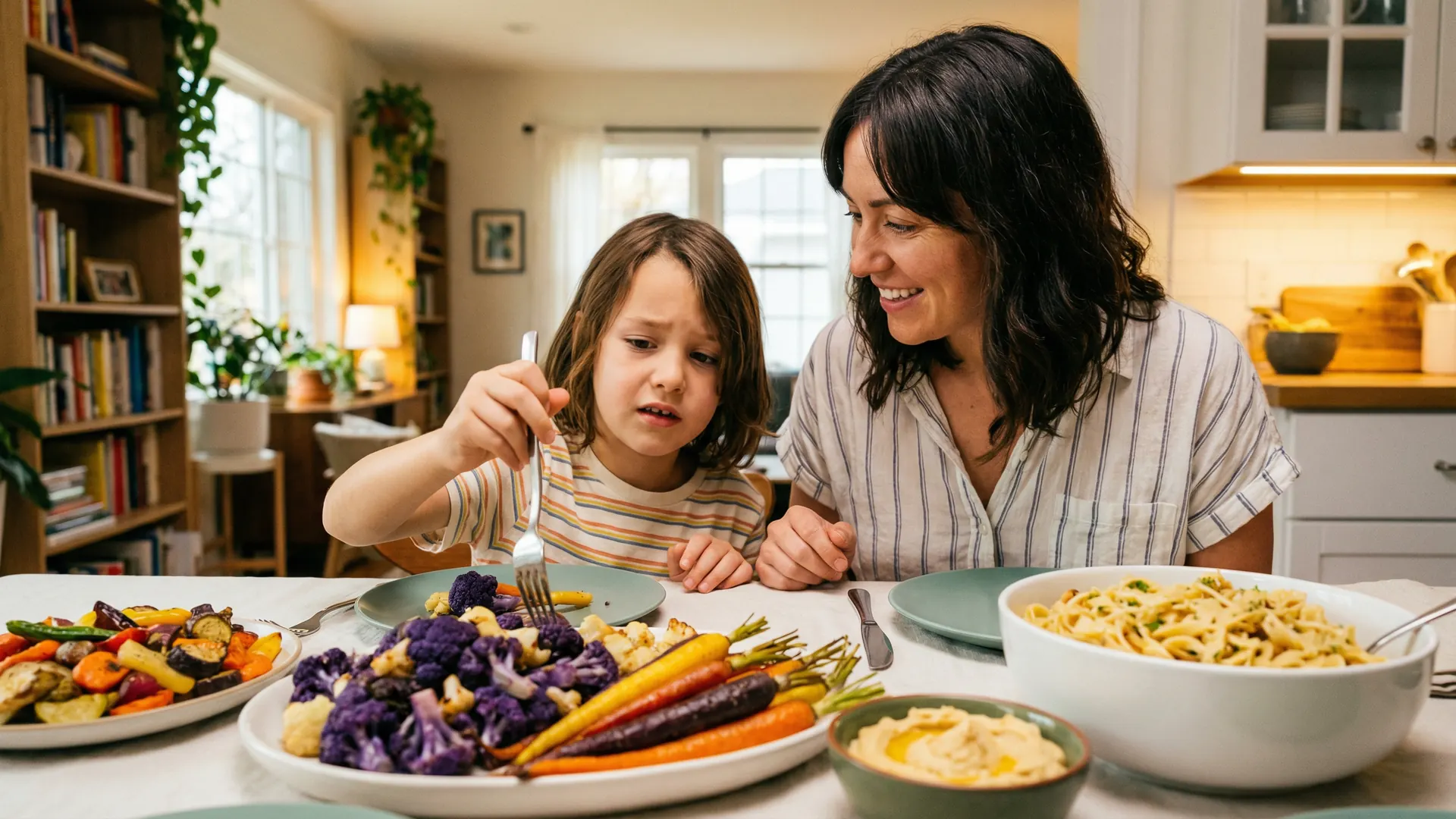
Sam: “I don’t want that. I’m not eating that.”
Emma: “Is there cheese? If there’s cheese, maybe. But if it looks green, no.”
Leo: “Can I have cereal instead?”
Your shoulders drop. You tried. Again. And the result is the same: another dinner of resistance, complaints, and wasted effort. You’re not alone — 87% of parents with school-age children navigate picky eating regularly.
But here’s the thing: picky eating isn’t a character flaw. It’s a developmental phase, a sensory preference, or a behavioral pattern you can actually shift — with the right approach.
The Picky Eater Spectrum: Where Is Your Child?
Picky eating is a journey, not a permanent state. Most children move through these stages over time:
The Refusers
"No new foods ever" — every meal is a battle
The Explorers
"I'll try it on my terms, in small amounts"
The Expanders
"I'll try anything once (but maybe not again)"
The Adventurers
"New foods are exciting!"
Most children start at Stage 1 or 2. With the right approach, they naturally progress. Family Voting accelerates this journey.
Why Family Voting Changes Everything
Traditional Approach
✗ Parent plans the week alone
✗ Hopes everyone will like it
✗ Prepares multiple variations
✗ Dinner becomes a negotiation
✗ "I didn't have a say — why should I eat it?"
Family Voting Approach
✓ Parent shares meal plan options
✓ Everyone votes: 👍 😐 👎
✓ Votes are visible to all members
✓ Majority wins — everyone heard
✓ "My vote counted — I'll try it"
Why does this work? Because power shifts — and with power shifts, resistance fades. Learn more about the Family Voting feature.
The Psychology That Actually Makes Kids Try New Foods
What We’re NOT Saying
❌ Forcing kids to eat will make them adventurous
❌ Kids should eat everything adults eat immediately
❌ Picky eating is just attention-seeking
What We ARE Saying
✅ When kids feel heard, they're less defensive
✅ Low-pressure exposure builds trust over time
✅ Family voting reduces "I didn't choose this" resistance
1. The “No-Pressure” Exposure Rule
Children need an average of 7–15 exposures to a new food before they’ll even consider tasting it — and 15–30 exposures before they’re likely to enjoy it. Those exposures should be low-pressure, positive, and repetitive. No force-feeding, no shaming, no “you’re not leaving the table until you finish this.”
2. The “Agency Effect”: When Kids Choose, They Try
Kids who are invited to participate in meal selection are 3.5× more likely to try new foods. They feel proud of their choices — even when they choose something “weird.”
3. The “Peer/Voting” Psychology: “Everyone Else Said Yes”
When a child sees that Mom, Dad, and their sibling all voted yes on a meal they voted no on, something shifts. “What do they see in this that I don’t?” The fear of the unknown is reduced because trusted voices said it’s okay.
Real Stories: How Family Voting Changed Dinner Tables
The Miller Family — Austin, TX
"My 9-Year-Old Now Tries Thai Curry"
BEFORE
Chloe (9) only ate chicken nuggets, plain pasta, and cheese. Dinner was a negotiation every night.
AFTER
After 5 weeks: Chloe tries 1–2 new meals/week, even asks for spicy food. Week 3: she voted "maybe" on Thai curry because her Dad voted yes. Week 4: she voted yes, tasted it — and enjoyed it.
"Voting wasn't just about picking food. It was about Chloe feeling like her opinion mattered. She trusted us more, because we trusted her."
The Chen Family — San Francisco, CA
"Twins Who Never Ate Veggies Now Ask for Salad"
BEFORE
Twins (8) absolutely refused vegetables in any form. Parents hid veggies in purees — kids eventually caught on.
AFTER
After 7 weeks: twins voted weekly, excited to see results of "their" plan. Week 4: voted "maybe" on Thai-style vegetable stir-fry. Now they ask: "Are there vegetables in this? Can you add them?"
"They feel like they're part of a team, not just passengers at a buffet of parent decisions."
The Garcia Family — Phoenix, AZ
"No More 'I Didn't Choose This'"
BEFORE
Diego (7) resisted every new meal with "I didn't want this." Parents wasted food, tension at every dinner.
AFTER
After 4 weeks: Diego still says no to some meals, but respects the vote — "I voted no, but everyone else said yes, okay." Less waste, less stress.
"He still doesn't eat everything, but he accepts it. That's progress."
6 Practical Tips: How to Use Family Voting Effectively
Family Voting isn’t just clicking buttons — it’s about how you use it to build trust and expand palates.
Start with "Maybe" Options
A "maybe" vote is a win — it means they're considering, not actively rejecting. Celebrate maybe votes. They're progress, not failure.
Vote BEFORE Shopping
Don't shop, then ask 'What do you think?' Let everyone vote first, then shop. This eliminates 'we already bought it, you have to eat it' guilt trips.
The Three-Bite Rule for Maybe Votes
First bite: "Just try it." Second bite: "Wait 10 minutes, try again." Third bite: "One last try — if you still don't like it, you're done." Three bites. Low-stakes, respects autonomy.
Pair New with Familiar
Don't make the whole meal new. Familiar pasta sauce with mushrooms as a separate side option. Reduces stress and builds willingness to try.
Celebrate Yes Votes, Don't Shame No Votes
When someone votes yes: "Awesome! Thanks for trying something new!" When someone votes no: "Okay, that's fair. Your vote counts." No shaming.
Let Kids Suggest One Meal/Week
"One meal this week is yours to suggest." Some kids choose safe options — that's fine! Others might surprise you with tacos, curry, or even sushi.
What Happens After 30 Days of Family Voting?
Based on family research case studies, here’s what typically improves after a month of using Family Voting:
| Metric | After 30 Days | After 90 Days |
|---|---|---|
| Meals rejected at dinner | ↓ 40% fewer | ↓ 65% fewer |
| "I don't want to eat this" comments | ↓ 55% | ↓ 80% |
| Kids willingly trying new foods | ↑ 45% | ↑ 70% |
| Dinner time stress / arguments | ↓ 50% | ↓ 75% |
| Food waste (uneaten meals) | ↓ 35% | ↓ 60% |
| Kids asking to help plan/cook | ↑ 60% | ↑ 80% |
Based on family meal behavior studies and the University of Minnesota’s 2019 family meal participation research.
Picky eating doesn’t disappear overnight. This is a gradual shift — a reduction in resistance, not an elimination. Try FamilyPlate free — 7-day meal plan.
When Family Voting Doesn’t Fix Everything (And That’s Okay)
Real talk — voting isn’t a magic wand for every child. Some kids have stronger sensory processing differences, anxiety around new foods, or will always prefer limited “safe foods.”
For these families, Family Voting still helps — because their voice is respected, they’re not forced into “I didn’t choose this” battles, and stress still decreases even if food expansion is slower.
Progress over perfection. That’s the mantra.
The Bottom Line: You’re Not Failing at This
Picky eating is exhausting. You’re not imagining it. You’re not a bad parent. And most importantly — there are proven ways to navigate this journey that don’t involve force-feeding, shame, or constant arguments.
Dinner can be peaceful someday — it starts with including your family in the process, not excluding them from it.
Turn Picky Eating into Exploration
Try Family Voting free for 7 days.
No credit card required. Setup takes 2 minutes.
Get Your Family Voting Link →