
The Grocery Receipt That Keeps Growing (And Why You Keep Paying More)
You’ve been there. It’s Tuesday evening, you’re at the grocery store, already tired, and you’re grabbing items:
“We probably need yogurt...”
“Oh, garlic—we’re out, right?”
“Vegetables, check. Fruit, check.”
“Wait, did we already buy chicken this week?”
You get home, unpack—and realize you have:
- 3 containers of yogurt (two from last week, one new)
- A full bag of garlic (when you already had full bulbs at home)
- Vegetables you don’t actually cook with
- Chicken you forgot to use last week
This isn’t just annoying—it’s costing you. The average American family throws away $1,500–2,500 annually on groceries they never even ate. Food waste is silently becoming one of the largest recurring annual expenses for most families—bigger than some utility bills, bigger than many subscription services, and entirely preventable.
But here’s the thing: this isn’t because you’re disorganized or bad with money. It’s because current grocery shopping and meal planning systems were designed around buying, not using.
Where Your Grocery Money Actually Goes to Waste
Here’s the breakdown of where food waste hits hardest for the average family:
| Category | Annual Waste | % of Grocery Spend |
|---|---|---|
| Produce (fruits, vegetables) | $600 | 25–30% |
| Dairy (milk, cheese, yogurt) | $350 | 15–20% |
| Meat / Seafood | $400 | 15–20% |
| Bread / Bakery | $250 | 10–12% |
| Leftovers | $300 | 12–15% |
| Pantry items (spices, oils, grains) | $150 | 5–8% |
| Total Average Waste | $2,050 | 28% of spend |
Source: EPA Food Waste Research & USDA household food expenditure data.
Why Traditional Grocery Lists Produce Mountains of Waste
Here’s what happens when you use traditional grocery lists or write things on sticky notes:
Problem 1: You List What You “Think” You Need—Not What You Actually Have
You see “yogurt” on the grocery list, so you buy more. You get home and find 2 full containers already in the fridge. Result: expired yogurt + money thrown away.
Problem 2: No Quantity Consolidation
You buy “garlic” because it’s on the list. Then next week, garlic is again on the list. You buy more bulbs, unaware of accumulation over previous weeks.
Problem 3: Recipes Don’t Align with Inventory
You find a good-looking recipe online. You write down the ingredients you think you need. You’re halfway shopping and realize you already bought it last week—or you don’t check at all. Result: duplicate purchases, unused fresh produce.
Problem 4: The “I’ll Use It Later” Fallacy
You buy fresh spinach because “we’ll use it with meals this week.” Life gets busy—you make takeout instead of cooking twice. Spinach wilts, becomes compost. Result: wasted money + guilt + planning resentment.
The problem isn’t that you forget or are disorganized—it’s that the system is tracking purchases, not consumption.
How FamilyPlate’s AI Solves Food Waste
FamilyPlate wasn’t built just to generate recipes—its core intelligence was designed to eliminate the inventory blind spot that causes waste. Here’s how it works, step-by-step:
Step 1
Family Votes on Meals, Creating a Plan
7 days of meals are selected. Every family member votes, reducing the chance of rejection. Only approved meals go into the plan — no random selections.
Step 2
AI Extracts All Ingredients From Chosen Meals
The AI reads every recipe in the plan. It identifies which ingredients are needed and in what quantities. Example: "You need 6 cloves garlic, 2 lbs tomatoes, 1 gallon milk" — not: "buy garlic, buy tomatoes, buy milk."
Step 3
AI Cross-References and Consolidates
Smart aggregation: if three recipes call for garlic, you get ONE entry: "6 cloves garlic." The AI learns what you always have (oil, spices, rice) and stops listing them every trip. Seasonal awareness: fresh herbs and berries only listed if they'll be used in the next 5–7 days.
Step 4
Smart Shopping List — Organized by Aisle
Produce, dairy, bakery, meat — everything organized in the order you'll pass it in the store. Quantities consolidated. Items grouped by when they'll be used (this week vs. next week).
Step 5
Real-Time Sync & Update
If someone eats an item, it's marked "used" on the list. If you swap one meal for another, the list updates automatically — you don't buy ingredients you won't use. No waste — because you only bought what you planned to cook.
Explore the automatic grocery list feature →
What a Smart Shopping List Actually Looks Like
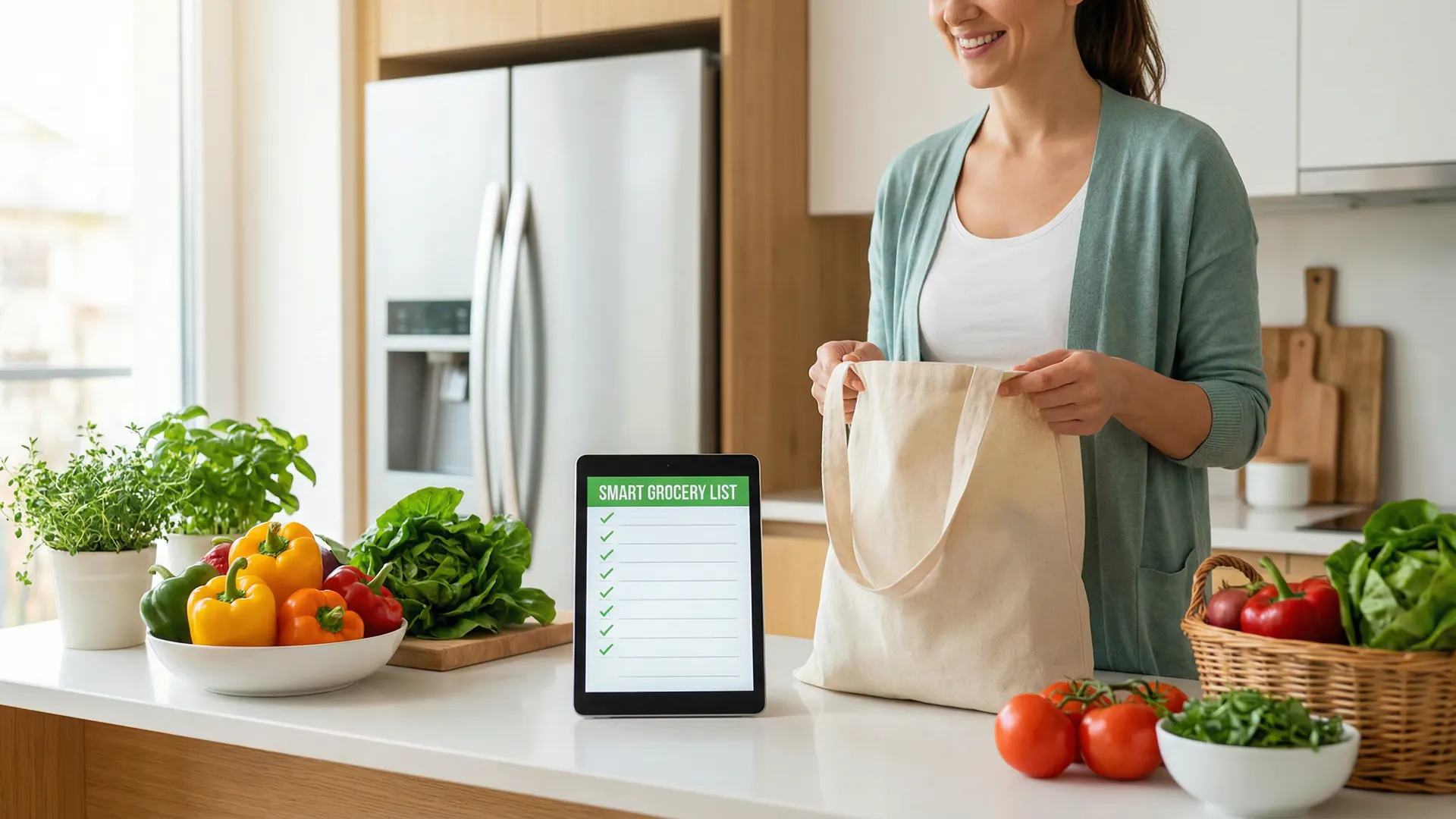
FamilyPlate Smart List — Week of Feb 22
Produce (Aisle 1)
✓ 3 onions
✓ 2 lbs tomatoes
✓ 6 cloves garlic
✓ 1 bunch fresh basil
Dairy (Aisle 2)
✓ 1 gallon milk
✓ 8 oz cheddar cheese
Bakery (Aisle 3)
✓ 1 loaf whole wheat bread
Meat (Aisle 4)
✓ 2 lbs chicken breast
✓ 1 lb ground beef
Each item consolidates what 3 recipes need. Nothing duplicates.
Real Families: How Smart Lists Changed Their Grocery Bill
The Robinson Family — Denver, CO
"From $2,100/month to $1,500/month"
BEFORE
Monthly grocery spend: $2,100. Food waste: ~30% ($630/month thrown away). Fridge overflowing with "we thought we'd use this" items.
AFTER
Monthly grocery spend: $1,500. Food waste: ~8% ($120/month). $600 saved/month → $7,200/year saved.
"The key difference was that the AI learned what we actually eat and stopped listing things that sit on the shelf."
The Kim Family — Seattle, WA
"Went From 'Buy Everything' to 'Buy Exactly What We Need'"
BEFORE
Weekly grocery rush: "Just grab what looks good." Fridge always half-full of spoiled produce. Threw away $40–50/week in wasted food.
AFTER
Shopping list consolidated quantities perfectly. Fridge now rotates food properly, almost zero waste. Saving: ~$200/month → $2,400/year saved.
"My wife doesn't make lists anymore — she shares the FamilyPlate link, we vote, and the list is waiting. It's been a game changer."
The Patel Family — San Jose, CA
"Vegetarian Food Waste Reduced 70%"
BEFORE
Vegetarian family with lots of vegetable/produce waste. Weekly trips to multiple stores, still throwing away fresh items. Estimated waste: $350/month.
AFTER
AI consolidated recipe ingredients (no duplicate vegetable purchases). Organized by how soon items need to be used. Waste reduction: from 30% to under 8%. Saving: ~$280/month → $3,360/year saved.
"For vegetarians, produce waste is the biggest issue. The smart list fixed that overnight. We now use everything we buy."
The Environmental Impact That Also Saves Money
Food waste isn’t just a financial problem—it’s an environmental catastrophe with your wallet front-and-center.
What You Save Financially
💰 $2,500/year = 2 months’ groceries
✈️ = 1–2 family vacations
🛋️ = New furniture or electronics
What You Save Environmentally
🌍 3,500 lbs of CO₂-equivalent emissions
💧 5,000 gallons of water wasted on food you never ate
🚗 Transportation emissions for 500 grocery runs = saved
5 Practical Tips: How to Use Smart Lists to Eliminate Waste
FamilyPlate’s AI does most of the work, but how you use the list matters. Here are evidence-based tips:
✅ Tip 1
Check Fridge/Pantry Before Sharing the Family Voting Link
Before the family votes, do a quick 2-minute fridge-pantry scan. Mark in app what you already have. This prevents inventory blindness before it even happens.
✅✅ Tip 2
Vote BEFORE Shopping — Not After
Don't grocery shop THEN ask family what they think (that's backward). Share voting link → get votes → create shopping list → THEN shop. This aligns purchases with plans, not randomness.
✅✅✅ Tip 3
Stick to the List — One Shopping Trip Per Week
One weekly trip: AI predictions accurate (waste = 8–12%). 2–3 weekly trips: predictions break (waste = 18–25%). "I'll just stop and grab something": waste increases 40% on those side trips.
✅✅✅✅ Tip 4
Eat the First 3 Days Planned, Then Adjust
Week 1: Eat exactly what's planned. No substitutions. Week 2: You now have more flexibility — swap based on what worked, what didn't. This builds trust in the plan over time.
✅✅✅✅✅ Tip 5
Rotate Perishables First
The smart list organizes items by use urgency: "For this week → Use first: fresh herbs, berries, fish." "For next week → Can wait: grains, frozen items, canned goods." When shopping, prioritize the "this week" items and check them off first.
What Happens After 30 Days of Smart List Shopping?
Based on family case studies and EPA waste data, here’s typical progress:
| Metric | Traditional | After 30 Days | After 90 Days |
|---|---|---|---|
| Food waste as % of spend | 25–30% | 12–15% | 8–10% |
| Annual grocery spend | $1,200/mo | $950/mo | $800/mo |
| Expired items thrown away | 8–12/month | 3–4/month | 1–2/month |
| Last-minute grocery trips | 2–3/week | 1/week | 0.5/week |
| Monthly savings | — | $250/mo | $400/mo |
| Annual savings | — | $3,000/yr | $4,800/yr |
The Full ROI: $5,340/Year Saved
Traditional Shopping (Before)
Grocery spend: $1,200/month
Food waste: $300/month (25%)
Annual: $1,500 waste + $14,400 groceries
= $15,900/year total
Smart List (After 90 Days)
Grocery spend: $800/month
Food waste: $80/month (10%)
Annual: $960 waste + $9,600 groceries
= $10,560/year total
Net savings: $5,340/year
For doing nothing differently except using the smart list.
The Bottom Line: Stop Paying For Food You’ll Never Eat
You’re not paying for groceries—you’re paying for food, energy, water, transportation, and emissions for food that:
- You never got around to cooking
- You forgot you had (inventory blindness)
- Expired before you could use it
- You bought because the list said so (not because you planned to eat it)
FamilyPlate’s smart list solves one problem at its core: align what you buy with what you plan to eat.
When you do that, waste disappears. Bills drop. Stress decreases. And dinners become peaceful—because you’re not racing to use fresh items before they rot—they’re already in your plan.
$2,500/year is too much to throw away on nothing. Let’s fix it together.
Start Saving Money Today
Try FamilyPlate smart lists free for 7 days.
Calculate your potential savings: $3,000–4,800/year.
No credit card required.
Get Your Free Savings →