
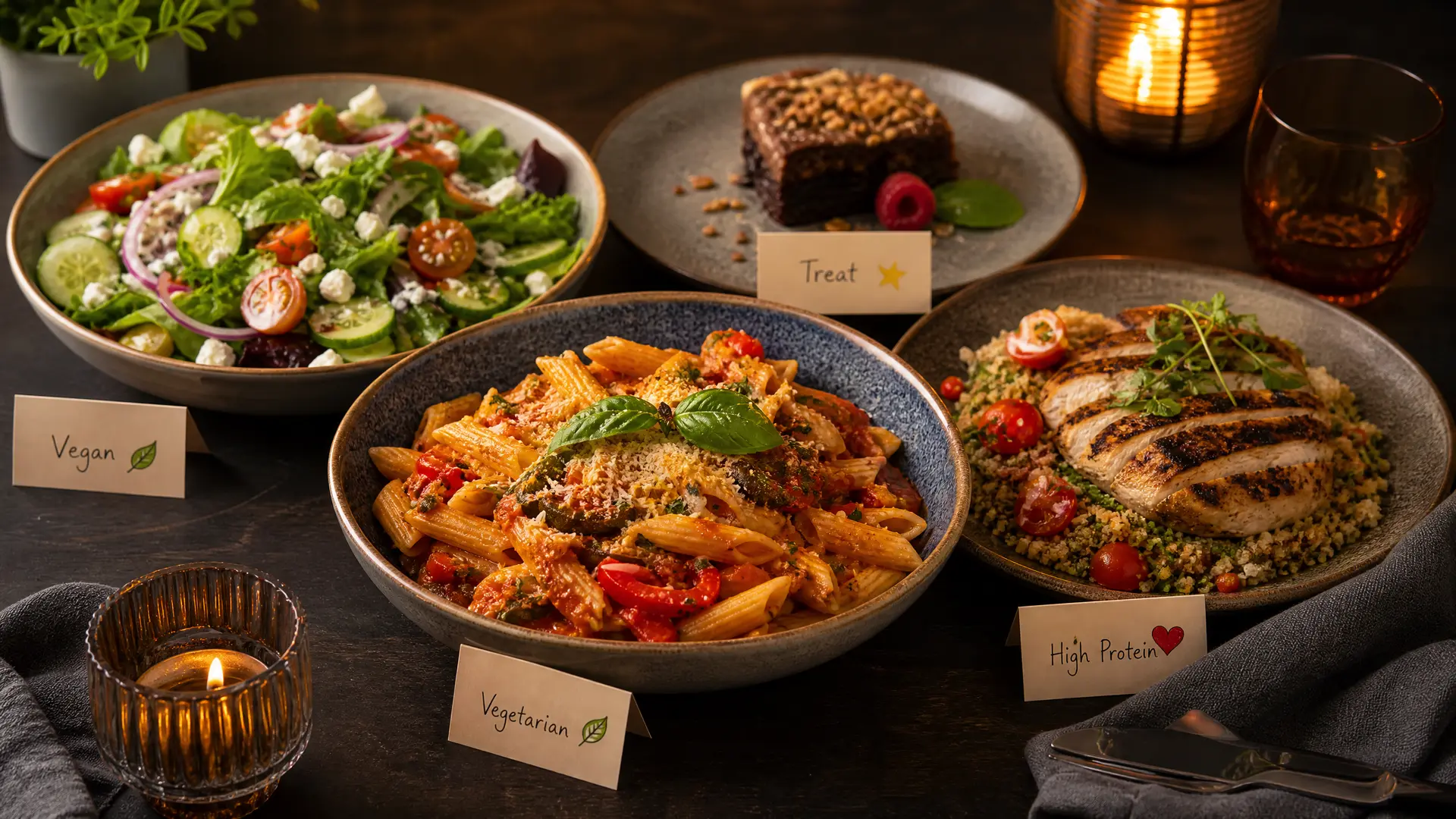
The Static Cookbook Failure
Traditional cookbooks and generic recipe websites are built on a fundamental flaw: they assume a single, idealized reader with no dietary restrictions, no picky eaters in the house, and an infinite amount of prep time. But for real families, meal planning is a complex multi-user constraint problem.
When one child is allergic to dairy, another refuses to eat anything green, and one parent is trying to hit a specific protein target, a static recipe book becomes useless. Staring at pages of beautiful food photography trying to manually calculate how to modify a recipe to satisfy everyone is a massive source of mental fatigue. According to research, people make over 200 food-related decisions every single day, and by evening, this decision fatigue makes ordering takeout look incredibly attractive.
What is "Family Food DNA"?
At FamilyPlate, we don't believe in generic meal plans. Instead, our system builds a dynamic, collective model of your household's unique preferences, which we call your "Family Food DNA."
Instead of treating your family as a single unit, the AI treats your household as a small, collaborative network. It tracks individual dietary profiles, allergy flags, and taste preferences, then mathematically intersects them to find the "sweet spot"—meals that are safe for the allergic child, exciting for the parents, and acceptable to the picky eater.
| Learning Method | How the AI Tracks It | Impact on Your Plan |
|---|---|---|
| Explicit Preferences | Onboarding dietary flags, hard ingredient exclusions, allergy settings | Filters out unsafe or completely disliked recipes immediately. |
| Implicit Feedback | Which recipes you skip, favorite, swap out, or adjust during the week | Refines the ranking of future recipe suggestions over time. |
| Collaborative Voting | Individual thumbs-up/thumbs-down votes from family members on proposed meals | Builds a consensus score to prioritize highly approved dishes. |
How the AI Taste Profile Algorithm Learns
Our personalization engine doesn't just look at ingredients; it looks at sensory attributes, prep complexity, and nutritional density. The algorithm learns in three continuous loops:
1. Ingredient Exclusions and Sensitivities
This is the baseline layer. If you flag a dairy allergy or exclude cilantro, the AI immediately redacts those components across the entire recipe database, ensuring P0-level allergy safety without you ever needing to double-check a label.
2. Taste and Texture Mapping
The system categorizes recipes by flavor profiles (spicy, savory, sweet, mild) and textures (crunchy, smooth, soft). If your children consistently down-vote mushy textures, the AI adapts, shifting suggestions toward roasted or crispy options instead.
3. Time and Complexity Matching
The AI learns your scheduling patterns. If you consistently swap out complex recipes on Thursdays for under-15-minute meals, the algorithm notes this behavioral pattern and automatically schedules fast-cooking options on your busiest weeknights.
Why Personalization is Critical for Family Health
Generic, restrictive meal plans fail because they are unsustainable. When a plan is too difficult to follow or ignores a family's cultural and taste preferences, parents abandon it. A study published in the International Journal of Behavioral Nutrition and Physical Activity (Ducrot et al., 2017) concludes that structured, personalized meal planning is directly associated with healthier diets and lower rates of obesity, because it makes healthy eating realistic and repeatable.
Furthermore, when children are actively involved in choosing their meals, their willingness to try new foods increases exponentially. Research in Appetite (van der Horst et al., 2014) shows that children are significantly more likely to eat meals they had a direct role in selecting.
By combining AI learning with interactive family voting, FamilyPlate's personalized taste profile removes the friction from healthy eating, transforming dinner from a daily chore into a collaborative family event.