Why Italian Food Works So Well for Families
Walk into any Italian home on a Sunday and you will find the same thing: multiple generations crowded around a table, pasta in various stages of preparation, and children who are somehow both underfoot and essential to the process. Italian cuisine was not designed for restaurants — it was designed for families. That is precisely why it translates so well to the modern family kitchen.
The architecture of Italian cooking is inherently adaptable. A bolognese sauce can be mild for children and heavily seasoned for adults. A pizza base is a blank canvas that every family member can customise. A risotto can be made with whatever is in the fridge. And crucially, the techniques are simple enough that children can participate from a young age — which, as any parent knows, is the single most reliable way to get a picky eater to try something new.
The 5 Principles of Italian Family Cooking
Before diving into the recipes, it is worth understanding why Italian food succeeds where other cuisines sometimes struggle with children. These five principles explain the phenomenon — and they are the same principles that make family meal planning with Italian cuisine so effective.
| Principle | Why It Works for Kids | Example |
|---|---|---|
| Fewer ingredients | Less sensory overwhelm — familiar flavours dominate | Cacio e Pepe: pasta, cheese, pepper |
| Mild base flavours | Tomato, olive oil, and cheese are universally accepted | Margherita pizza |
| Customisable format | Every family member can adapt their own portion | Pizza toppings, pasta shapes |
| Hands-on preparation | Kids who make it, eat it — proven psychology | Rolling pasta, shaping meatballs |
| Comforting textures | Soft pasta, creamy risotto, melted cheese | Mac & cheese is just Italian |
The 14 Recipes: Organised by Category
The following recipes are organised into four categories that reflect how Italian families actually cook: pasta and risotto for weeknight staples, pizza and flatbreads for weekend projects, soups and stews for colder months, and chicken and meat dishes for variety. Every recipe has been tested with children in mind — spice levels are noted, and substitutions for common picky-eater objections are included throughout.
Use the interactive demo below to browse all 14 recipes, save your favourites, and see how FamilyPlate's Italian meal plan adapts each dish to your family's specific preferences.
Your Italian Meal Plan · Family of 4
14 Authentic Recipes
Loved by all ages
Swap mushrooms for peas for picky eaters
Reduce chilli for kids
Kids love rolling the dough
FamilyPlate AI · Adapted to your family's taste profile
Get Full Plan →Live demo · Tap + to save meals · Your full plan adapts to every family member's preferences
Pasta & Risotto: The Italian Weeknight Foundation
Pasta is the backbone of Italian family cooking — and for good reason. It is fast, cheap, endlessly variable, and almost universally loved by children. The key to making pasta work for a family with diverse preferences is understanding that the pasta itself is neutral: the sauce is where all the adaptation happens.
Classic Spaghetti Bolognese is the entry point for most families. The meat sauce can be made mild or rich depending on preference, and it freezes beautifully — making it ideal for batch cooking on a Sunday. Creamy Mushroom Risotto is the vegetarian counterpart: swap mushrooms for peas or sweetcorn if your children object to the texture, and the result is equally satisfying. For a quick weeknight option, Penne all'Arrabbiata takes 25 minutes and requires only pantry staples — simply reduce the chilli for younger children.
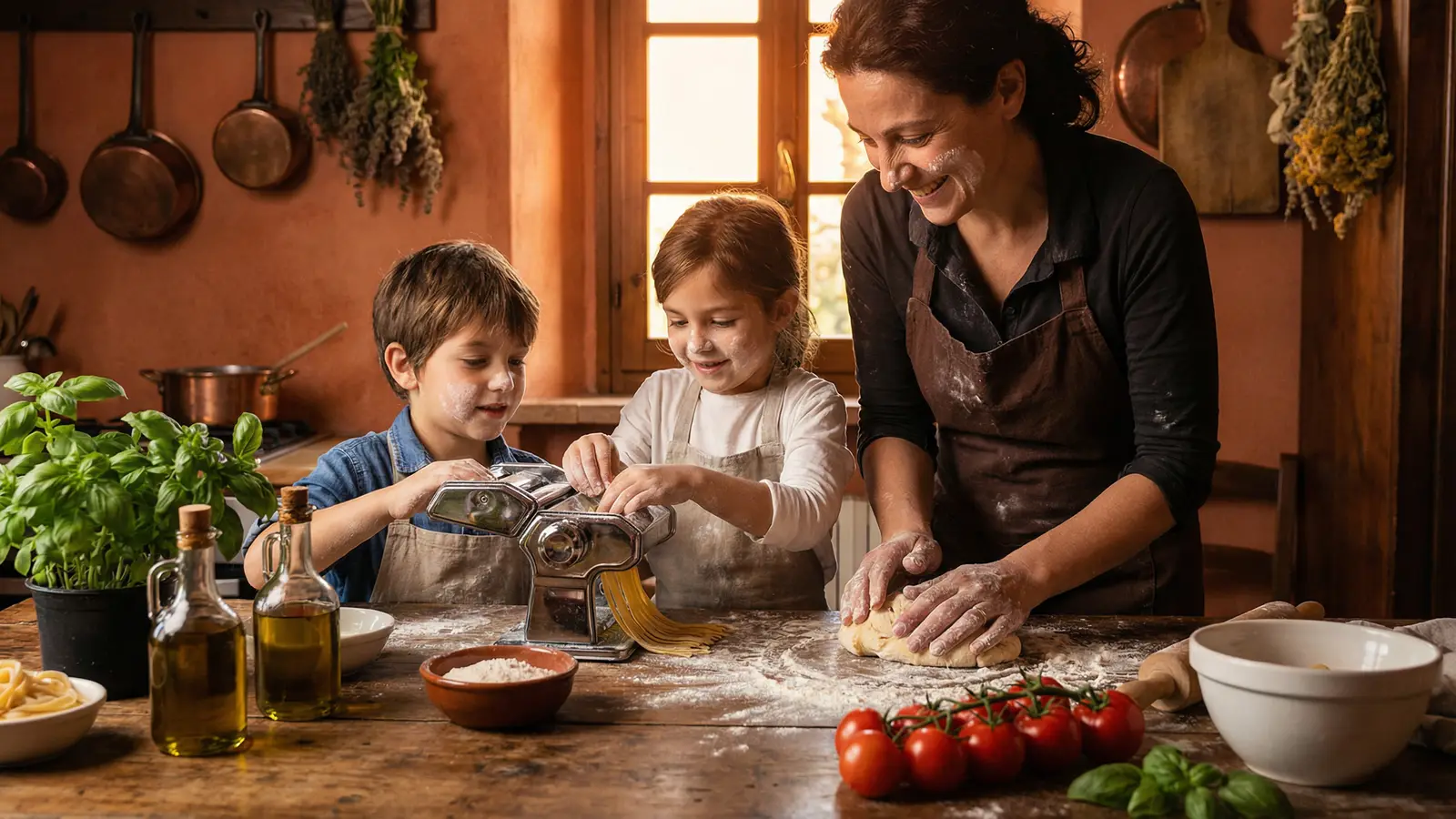
The weekend project worth attempting at least once is Homemade Tagliatelle. Children who roll pasta dough are almost always willing to eat what they have made — and the process itself is genuinely enjoyable. FamilyPlate's grocery list will automatically include the right quantities of flour and eggs based on your family size.
Pizza & Flatbreads: The Weekend Project That Always Wins
Pizza night is not just a meal — it is an event. The key to making it work for a family with different preferences is the assembly format: everyone gets their own section of the pizza, or their own personal base, and adds exactly what they want. This eliminates the negotiation entirely.
Margherita Pizza with homemade dough is the gold standard. The dough takes 15 minutes to prepare and 30 minutes to prove — during which time children can prepare their toppings. Focaccia with Rosemary and Olive Oil is a simpler weekend bake that doubles as a side dish or afternoon snack. And Calzone — the folded pizza — has a particular appeal for children who like the idea of a “secret” filling inside their food.
How FamilyPlate Builds Your Italian Meal Plan
The challenge with Italian cooking for families is not the recipes themselves — it is the coordination. Which dishes work on a Tuesday when you have 30 minutes? Which ones are worth saving for Sunday? How do you balance pasta nights with protein-rich options? And how do you generate a grocery list that accounts for overlapping ingredients across five different recipes?
FamilyPlate's Italian meal plan handles all of this automatically. It reads your family's taste profiles — including each child's preferences and any dietary restrictions — and builds a week of Italian meals that works for everyone. The grocery list is generated automatically, aggregated by aisle, with quantities calculated for your exact family size.
What FamilyPlate Does for Italian Meal Planning
Cuisine-specific plans
Full Italian meal plans built around your family's preferences
Per-member adaptation
Mild for kids, full-flavoured for adults — same dish, different portions
Automated grocery list
Ingredients aggregated across all 14 recipes, by aisle
Family voting
Kids vote on which Italian dishes appear in the weekly plan
Time-aware scheduling
Quick pasta on Tuesday, weekend pizza project on Saturday
No repeats
Rotation logic ensures variety across the full recipe library
Making Italian Cooking a Family Ritual
The most important thing Italian food teaches families is that cooking is not a chore — it is a ritual. Sunday pasta is not just about the food. It is about the hour spent together at the kitchen table, children learning to roll dough, the smell of tomato sauce reducing on the stove, and the satisfaction of eating something you made together.
Research consistently shows that children who participate in cooking are more willing to try new foods, eat more varied diets, and develop a healthier relationship with food overall. Italian cuisine, with its hands-on preparation and simple techniques, is the ideal entry point for this kind of family cooking culture.
Start with one recipe this week. Let the children help. And use FamilyPlate to build the rest of the week around it — so that Sunday's pasta becomes the anchor of a full week of meals your family will actually look forward to.
Ready for Your Italian Meal Plan?
FamilyPlate builds a personalised Italian meal plan for your family in under 2 minutes — with an automated grocery list included.
Start Your Italian Meal Plan Free →