The “Too Spicy for Kids” Myth
The most common reason families avoid Indian cooking is the assumption that it is too spicy for children. This is a misconception rooted in restaurant Indian food — which is often calibrated for adults who want heat — rather than home Indian cooking, which is naturally adapted to the whole family. In most Indian households, the same dish is cooked for everyone: the spice level is simply adjusted at the source.
The 12 recipes in this guide are all naturally mild or easily made mild without losing their character. Butter chicken, for example, is one of the most popular dishes among children worldwide — its creamy tomato sauce has a sweetness that appeals to young palates. Dal tadka is protein-rich, warming, and requires no spice adjustment at all. The key is knowing which dishes to start with, and how to adjust the ones that need it.
The Spice Adjustment Framework
Before the recipes, a brief framework for managing spice in Indian cooking for families. This is the same logic that FamilyPlate's taste profile system uses to automatically adjust every Indian recipe to your family's preferences.
| Spice Level | What to Reduce/Remove | What Stays | Suitable Age |
|---|---|---|---|
| None | All chilli, black pepper | Cumin, turmeric, coriander, garam masala | 12 months+ |
| Mild | Fresh/dried chilli | All aromatics, mild spices | 2 years+ |
| Medium | Half the chilli | Full spice blend | 6 years+ |
| Full | Nothing | Everything as written | Adults |
The 12 Recipes: Browse and Save
The recipes below are organised into four categories: curries and dals (the heart of Indian cooking), rice and breads (the essential accompaniments), snacks and sides (for variety and involvement), and vegetarian dishes (for families reducing meat or following a plant-based diet). Use the interactive demo to browse all 12 and save your favourites to your Indian meal plan.
Your Indian Meal Plan · Spice levels adapted per family member
12 Flavourful Recipes
Reduce chilli for young children — still rich and creamy
Protein-rich and naturally kid-friendly
Adjust spice to family preference
Great way to add greens for picky eaters
FamilyPlate AI · Spice levels auto-adjusted per family member
Get Full Plan →Live demo · Tap + to save meals · Spice levels adapt automatically to every family member
Curries & Dals: The Foundation of Indian Family Cooking
Butter Chicken (Murgh Makhani) is the ideal starting point for families new to Indian cooking. The sauce — a blend of tomatoes, cream, and aromatic spices — is rich, slightly sweet, and universally appealing. Reduce the chilli to zero for young children and the dish loses nothing of its character. It is also one of the best batch-cooking candidates in Indian cuisine: make a large pot on Sunday and it improves overnight.
Dal Tadka deserves more attention than it typically receives in Western households. Yellow lentils cooked with cumin, turmeric, and a tempering of garlic and mustard seeds — it is one of the most nutritionally complete dishes in Indian cooking, requiring no spice adjustment for children, and it costs almost nothing to make. Served with rice or naan, it is a complete meal in 30 minutes.
Palak Paneer — spinach and fresh cheese — is one of the most effective ways to introduce leafy greens to children who would otherwise refuse them. The paneer (a mild, firm cheese with a texture children tend to enjoy) anchors the dish, and the spinach blends into the sauce invisibly. It is, functionally, a way to serve spinach to children who think they hate spinach.
Rice & Breads: The Accompaniments That Make the Meal
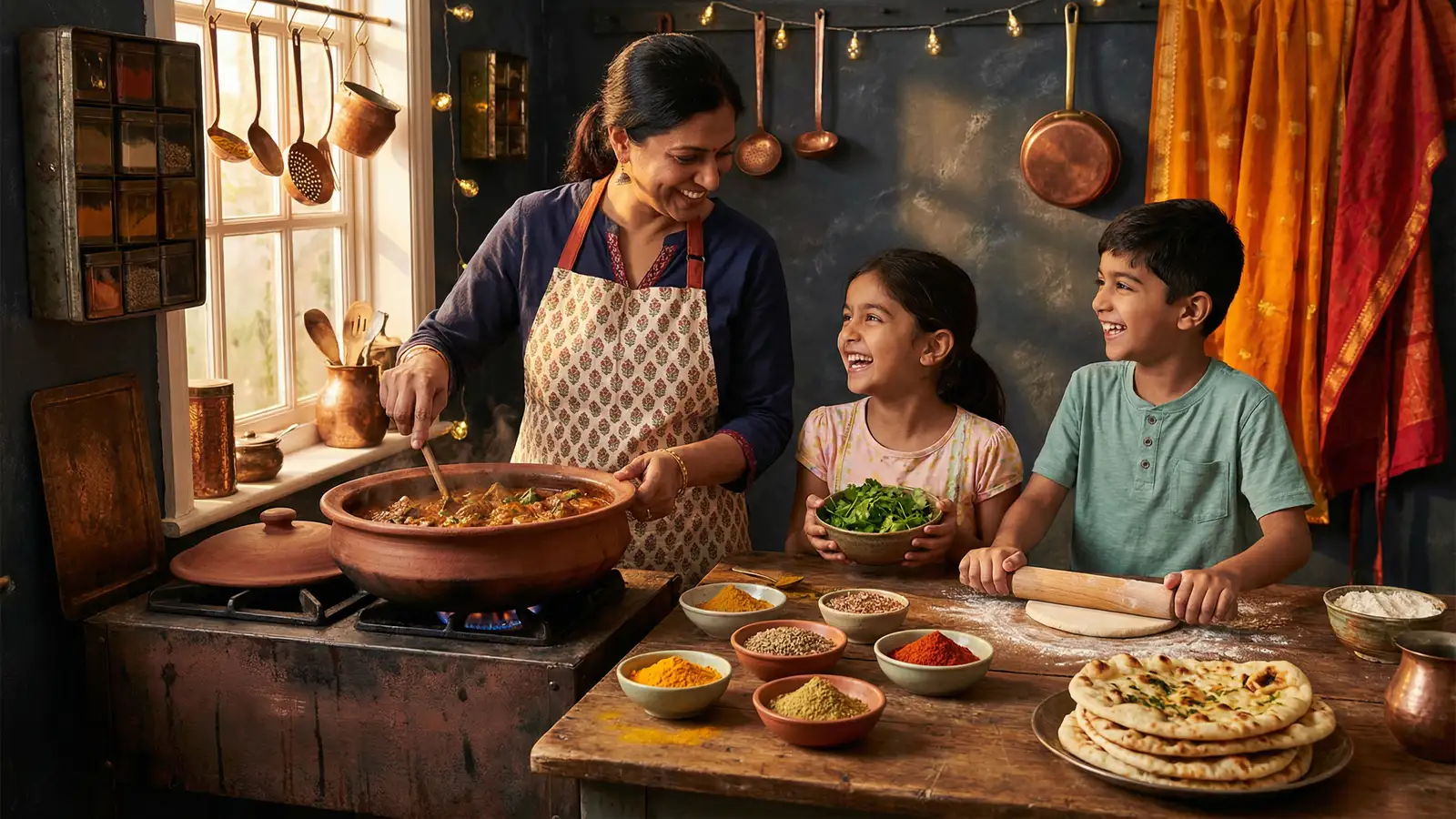
Vegetable Biryani is the one-pot Indian meal that works for the whole family. Fragrant basmati rice cooked with vegetables, whole spices, and saffron — it is a complete meal that requires no accompaniment and adapts easily to whatever vegetables your family prefers. Garlic Naan, made at home, is one of those recipes that children will request repeatedly: the dough is simple, the cooking is fast, and tearing warm naan and dipping it into curry is a universally satisfying experience.
How FamilyPlate Builds Your Indian Meal Plan
The challenge with Indian cooking for families is not the recipes — it is the coordination of spice levels across family members. A parent who wants full heat, a child who needs mild, and another family member who is vegetarian: managing this manually across a week of meals is genuinely complex.
FamilyPlate's Indian meal plan handles this automatically. Each family member's spice tolerance is stored in their taste profile, and every recipe is adjusted accordingly. The grocery list is generated automatically — with quantities calculated for your family size and ingredients aggregated across the full week.
FamilyPlate Indian Meal Plan Features
Per-member spice levels
Each family member gets their own spice setting — one dish, multiple heat levels
Dietary filters
Vegetarian, vegan, halal, and dairy-free variants auto-selected
Automated grocery list
Spices, lentils, and fresh ingredients aggregated by aisle
Family voting
Kids vote on which Indian dishes appear in the weekly plan
Time-aware scheduling
30-minute dals on weeknights, biryani on weekends
Full recipe library
Access to the complete Indian recipe library, updated regularly
The Bigger Picture: Indian Cooking as a Family Practice
Indian cooking has something that many Western cuisines lack: a deep cultural tradition of cooking as a family activity. Grinding spices, rolling roti, shaping samosas — these are tasks that children have participated in for generations. Introducing Indian cooking to your family is not just about adding variety to the weekly menu. It is about introducing a cooking culture where the kitchen is a place of collaboration rather than a solo production line.
Start with butter chicken this week. Let the children help with the naan. Use FamilyPlate to build the rest of the week around it — and within a month, you will have a repertoire of Indian family meals that everyone looks forward to.
Ready for Your Indian Meal Plan?
FamilyPlate builds a personalised Indian meal plan with automatic spice adjustments for every family member — in under 2 minutes.
Start Your Indian Meal Plan Free →