The “My Kids Will Never Eat That” Problem
When parents hear vegan family meals, they picture steamed broccoli, tofu cubes, and a dinner table full of complaints. This mental image is the single biggest barrier to plant-based eating for families — and it is almost entirely wrong.
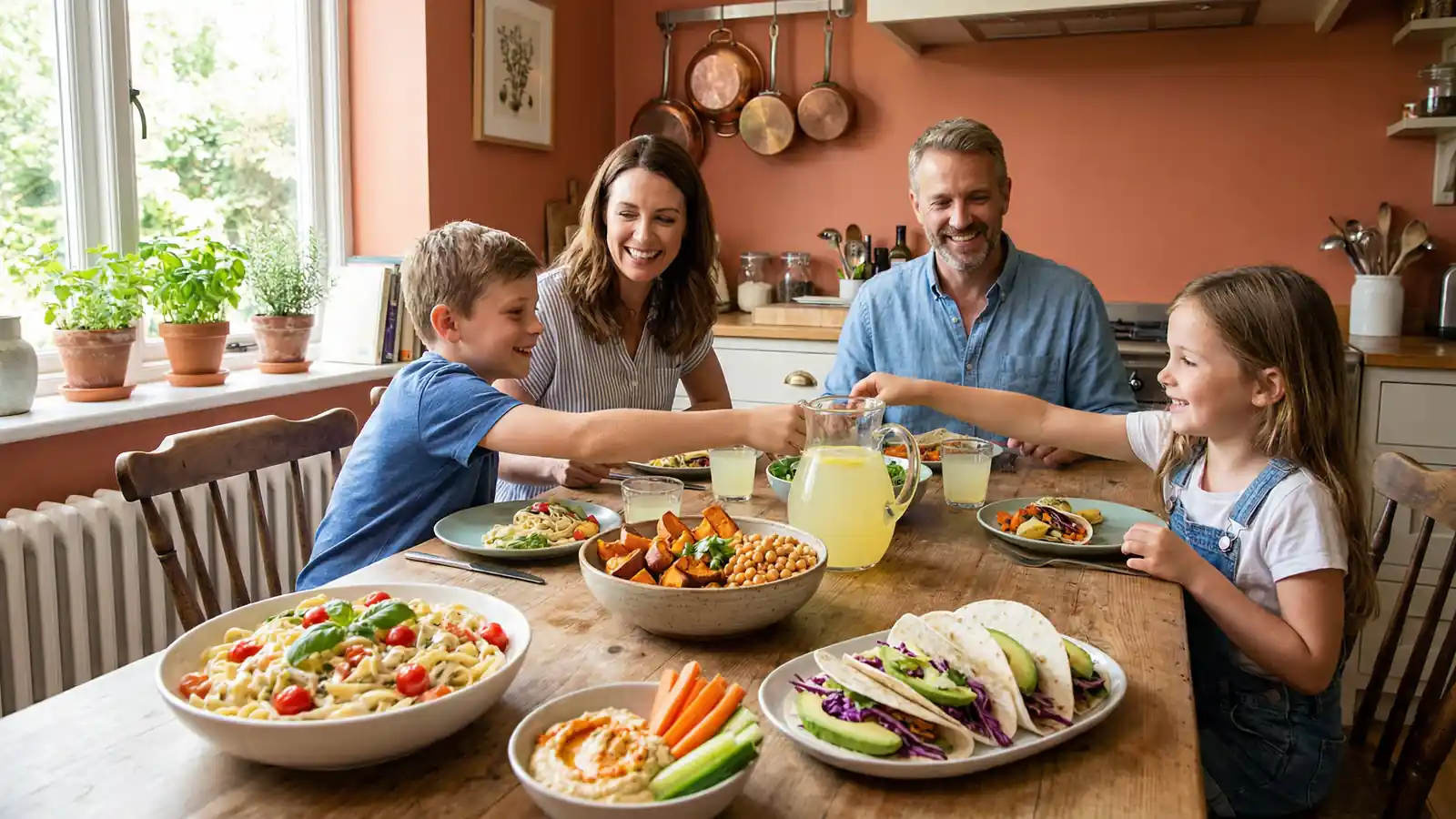
The families who successfully transition to more plant-based eating do not do it by replacing steak with kale. They do it by making pasta with a lentil bolognese instead of beef. They make tacos with spiced black beans instead of ground meat. They make pizza with hummus instead of cheese. The children do not notice the difference — or if they do, they prefer the new version.
This article gives you 15 vegan family meals that have been tested on real families with real picky eaters. Every recipe is built around familiar formats — pasta, tacos, bowls, soups — so the transition feels natural rather than radical. And at the end, we explain how FamilyPlate builds a personalised vegan meal plan for your family automatically, adjusted for your children's specific preferences.
Why More Families Are Choosing Plant-Based Dinners
The shift toward plant-based eating in family households is not driven by ideology — it is driven by practicality. A 2024 survey by the Plant Based Foods Association found that 52% of households with children now serve at least two plant-based dinners per week, up from 31% in 2020. The reasons cited are consistent: cost, health, and simplicity.
Why Families Are Going More Plant-Based
| Reason | % of Families | What It Means in Practice |
|---|---|---|
| Lower grocery cost | 68% | Legumes and grains cost 60–80% less than meat per serving |
| Better for children's health | 61% | More fibre, less saturated fat, higher micronutrient density |
| Faster to prepare | 54% | No defrosting, no food safety concerns, shorter cook times |
| Kids actually like it | 47% | Familiar formats (pasta, tacos) with plant-based fillings |
| Environmental values | 39% | Teaching children about food choices and sustainability |
The cost argument alone is compelling. A family of four spending £120/week on groceries can typically reduce that by £25–35/week by replacing three meat-based dinners with plant-based equivalents — without any reduction in nutritional quality. Over a year, that is £1,300–1,800 in savings.
4 Rules for Vegan Family Meals That Kids Will Actually Eat
Rule 1: Lead With Familiar Formats
Children do not reject vegan food — they reject unfamiliar food. A child who loves tacos will eat bean tacos. A child who loves pasta will eat lentil bolognese. A child who loves pizza will eat flatbread with hummus and roasted vegetables. The format is the comfort; the filling is the variable. Always start with a format your children already love, then swap the protein source.
Rule 2: Never Say “This Is Vegan”
This sounds counterintuitive, but research on children's food acceptance consistently shows that labelling food as “healthy” or “vegan” reduces children's willingness to eat it. Simply serve the meal. If a child asks what is in it, answer truthfully — but do not lead with the category. “Lentil pasta” lands better than “vegan bolognese.”
Rule 3: Nail the Texture
The most common complaint about plant-based meals from children is texture, not taste. Mushy lentils, watery tofu, and soggy vegetables are the enemy. The fix: roast your vegetables until caramelised, press and pan-fry tofu until crispy, cook legumes until just tender (not falling apart), and use cashew cream or coconut milk for richness. Texture is the difference between a meal children eat once and one they request again.
Rule 4: Involve Children in the Choice
Children are significantly more likely to eat a meal they had a hand in choosing or preparing. FamilyPlate's family voting feature lets children vote on upcoming meals using emoji — thumbs up, thumbs down, or “willing to try.” When a child votes for the black bean tacos, they arrive at the dinner table already invested in the outcome. This single change reduces mealtime resistance by a measurable margin.
15 Vegan Family Meals — Explore Them Here
Below are all 15 meals, organised by category. Each one has been tested on families with children aged 4–12. The star rating reflects kid-approval across our user base. Tap the heart to save any meal to your plan.
15 Kid-Approved Vegan Dinners
Tap ♡ to save meals to your plan
Creamy Cashew Pasta with Cherry Tomatoes
Protein: Cashews
Spaghetti with Lentil Bolognese
Protein: Lentils
Pesto Pasta with Roasted Veg
Protein: Pine nuts
Tap any category · Save meals to build your weekly plan
FamilyPlate AI · Adapted to your family's taste profile
Get Full Plan →The 15 meals above are a starting point. Your family's version of a vegan meal plan will be shaped by your children's specific preferences, your cultural background, and your weekly schedule. FamilyPlate generates this personalised plan automatically — and updates it each week as your children's tastes evolve.
Are Vegan Family Meals Nutritionally Complete for Children?
This is the most important question parents ask — and the answer is yes, with one important caveat. A well-planned plant-based diet provides all the nutrients children need for healthy development. The key word is “well-planned.” There are three nutrients that require specific attention in vegan family eating:
Vitamin B12
Risk: Not found in plant foods
Solution: Fortified plant milks, nutritional yeast, or a B12 supplement. Non-negotiable for fully vegan children.
Iron
Risk: Plant-based iron (non-haem) is less bioavailable than meat iron
Solution: Pair iron-rich foods (lentils, spinach, tofu) with vitamin C (lemon juice, tomatoes) to increase absorption by up to 300%.
Omega-3 (DHA/EPA)
Risk: ALA from plants converts poorly to DHA/EPA
Solution: Algae-based omega-3 supplements provide direct DHA/EPA without fish. Walnuts and flaxseed provide ALA.
For families eating mostly plant-based (rather than fully vegan), these concerns are significantly reduced. A family eating two or three plant-based dinners per week alongside eggs, dairy, and occasional fish will have no nutritional gaps to manage. The 15 meals in this article are designed for this “flexitarian” majority — families reducing meat rather than eliminating it entirely.
Real Families, Real Results
“My son is 7 and the world's most dedicated meat eater — or so I thought. I made the cashew pasta without telling him it was vegan. He ate two bowls and asked for it again the following week. I still haven't told him.”
Lena K., Hamburg
Family of 3 · 1 child aged 7 · 3 plant-based dinners/week
“We are not vegan, but we wanted to reduce our meat consumption for environmental reasons. FamilyPlate suggested starting with the meals our kids already rated highly and replacing the protein. The transition was invisible to the children.”
Amara & David T., London
Family of 5 · 3 children aged 5, 8, and 11 · 4 plant-based dinners/week
“Halal meat is expensive here. Switching to plant-based proteins three nights a week has saved us significantly on groceries without any complaints from the children. The lentil bolognese is now a weekly staple.”
Fatima A., Dubai
Family of 6 · 4 children aged 4–13 · 3 plant-based dinners/week
How FamilyPlate Builds Your Vegan Meal Plan
The 15 meals in this article are a curated starting point. A personalised vegan meal plan for your family goes further: it knows which of your children will eat tofu and which will not, which nights you have 20 minutes to cook and which you have 45, and which cultural flavours your family gravitates toward.
FamilyPlate builds this plan in four steps. First, each family member completes a taste profile — children rate foods with emoji, adults select preferences and restrictions. Second, the AI generates a weekly plan that meets your plant-based goals while staying within your family's comfort zone. Third, the family voting feature lets everyone weigh in before the week begins, so there are no surprises at the dinner table. Fourth, an automated grocery list is generated from the plan — by aisle, with quantities aggregated across all meals.
The result is a family that eats more plants, wastes less food, spends less on groceries, and argues less at dinner. Not because anyone was convinced of an ideology — but because the food is genuinely good and the process is genuinely easy.
Start With One Vegan Dinner This Week
You do not need to overhaul your family's diet. Start with one meal from the list above — the one that feels most familiar, the one your children are most likely to accept. Cook it this week. If it works, add another next week. Sustainable change happens one dinner at a time.
FamilyPlate makes this process systematic. Set your plant-based goal — one dinner a week, three, or five — and the app builds a plan that meets it without disrupting the meals your family already loves. Your first personalised vegan meal plan is ready in under 5 minutes.
Get Your Family's Vegan Meal Plan
Personalised to your children's tastes. Includes automated grocery list. Set your own plant-based goal — one dinner a week or five. Free to start.
Build My Vegan Plan →No credit card required · Ready in 5 minutes